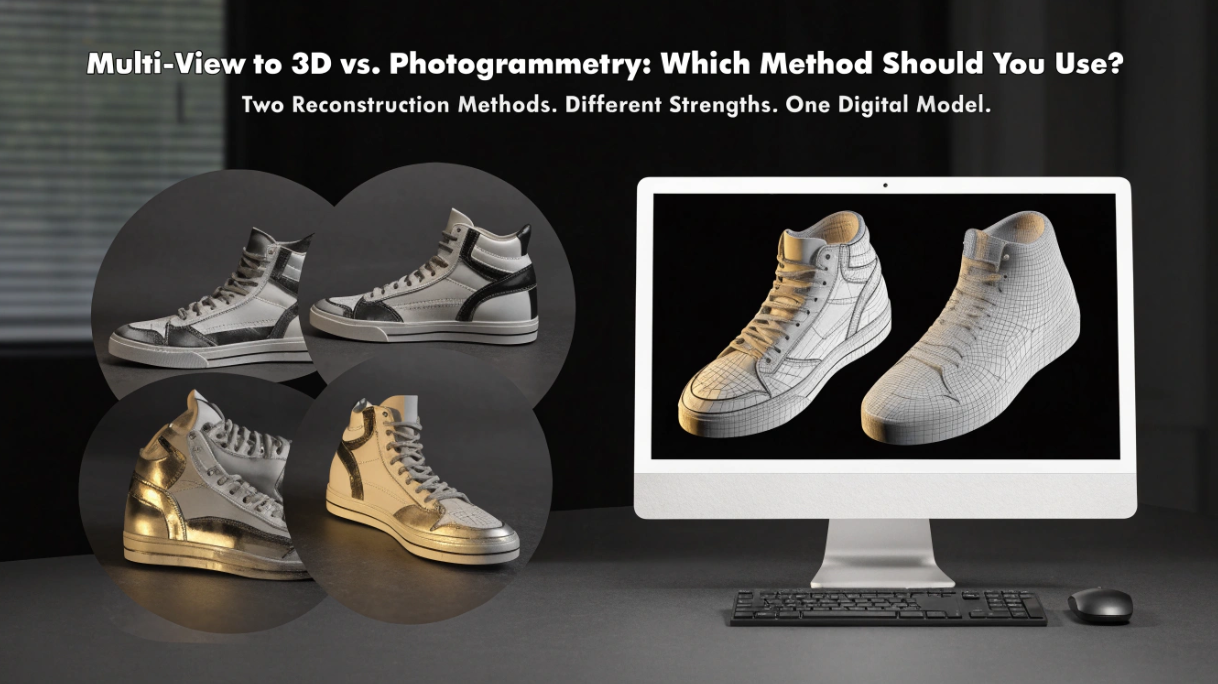
If you have ever tried to turn a real object into a digital model, you have probably run into two names: photogrammetry and AI-based reconstruction. Both use photographs. Both produce 3D meshes with textures. But they work differently, demand different effort, and suit different jobs.
This article compares the two approaches in plain terms, so you can decide which one fits your project. Along the way, it looks at how modern multi-view to 3d tools blend ideas from both worlds.
A Quick Look at Photogrammetry
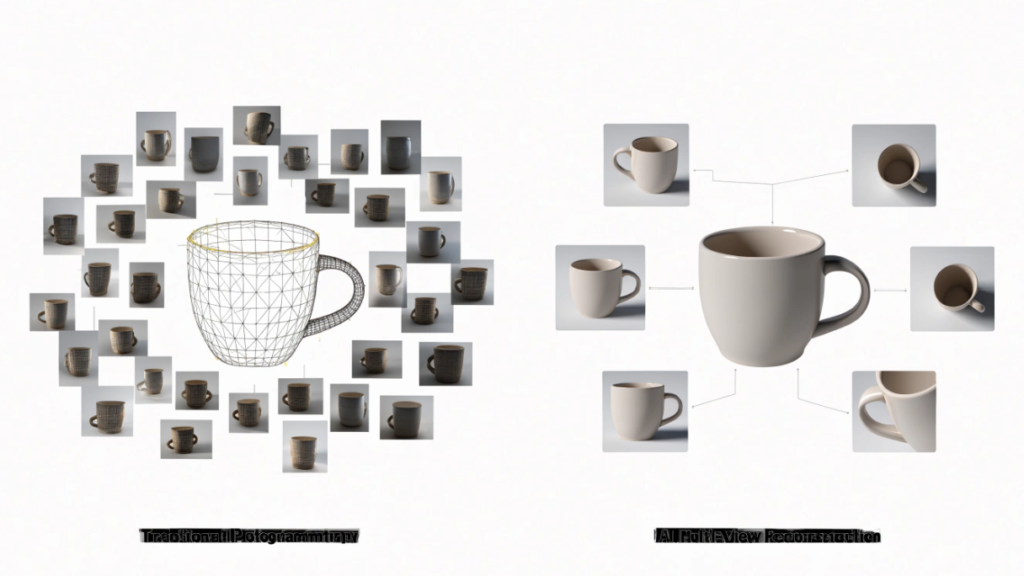
Photogrammetry is the established method for measuring and reconstructing objects from photos. You take many overlapping pictures of a subject, often between 30 and 200, sometimes more. Software then finds matching points across the images, calculates where each camera stood, and triangulates the position of millions of points on the surface.
The result is a dense point cloud, which is converted into a mesh and textured using the original photos. Because the process is rooted in geometry rather than guesswork, it can be extremely accurate when conditions are right. It has long been used in surveying, archaeology, film visual effects, and game development.
Its strengths are real:
- High fidelity. Fine surface detail can be captured faithfully.
- Measurable accuracy. With proper scale references, results can be used for measurement.
- Predictable behavior. The method is well understood and widely documented.
But so are its demands:
- Many photos. Capturing enough overlapping images takes time and discipline.
- Heavy processing. Large photo sets can take from minutes to hours, often needing a powerful computer.
- Fussy conditions. Shiny, transparent, or featureless surfaces tend to fail.
- Cleanup. Raw output is often noisy and needs significant editing.
How AI Multi-View Reconstruction Differs
AI-based multi-view systems also use several photos of the same object, but they need far fewer, commonly three to eight. They achieve this by combining geometric cues from the images with a learned understanding of how objects are shaped.
In other words, where photogrammetry relies on observing every part of the surface, an AI model can fill small gaps intelligently. If a patch of the object was not clearly photographed, the system predicts it based on what it has learned from large collections of 3D data.
This changes the trade-offs. A tool offering multiple images to 3d model conversion can often return a usable result in minutes from a handful of phone photos, with little technical setup. The price is that some regions may be inferred rather than measured, so strict accuracy is lower than in a well-executed photogrammetry capture.
Side-by-Side Comparison
| Factor | Traditional Photogrammetry | AI Multi-View |
| Photos needed | Dozens to hundreds | A few (often 3 to 8) |
| Processing time | Minutes to hours | Usually minutes or less |
| Hardware | Often a strong GPU | Typically handled online |
| Skill required | Moderate to high | Low |
| Accuracy | Very high when done well | Good, with some inference |
| Gap handling | Leaves holes | Fills plausibly |
| Difficult surfaces | Struggles | Somewhat more forgiving |
| Best for | Measurement, archival, VFX | Fast assets, products, prototypes |
Choosing Based on Your Goal
The better method depends less on which is “best” and more on what you need.
Choose photogrammetry when:
- You need dimensional accuracy, such as for engineering, restoration, or documentation.
- You are capturing large or complex subjects like buildings, terrain, or detailed sculptures.
- You have time to shoot extensively and the computing power to process the images.
- You require maximum surface detail for hero assets in film or games.
Choose AI multi-view when:
- You want a usable model quickly from a small number of photos.
- You are not an expert and prefer a simple workflow.
- The subject is a small to medium object, such as a product, toy, or prop.
- You will refine the model afterward and do not need survey-grade precision.
Consider combining them. Some artists use AI for a quick first pass to test whether an object is worth capturing in detail, and then commit to a full photogrammetry session only for the assets that justify it.
Capture Tips That Help Both Methods
Good photography improves results regardless of the software.
Use soft, even light. Overcast daylight or a shaded spot avoids harsh shadows that shift between shots.
Keep the subject sharp. Use a steady hand or tripod, and avoid motion blur.
Overlap your views. Each photo should share a large portion of its content with its neighbors.
Maintain a consistent distance. This keeps scale and focus steady across images.
Choose a neutral background. A plain backdrop reduces confusion and makes subject isolation easier.
Cover all sides. Include top and bottom views when they matter, flipping the object if needed.
Avoid problem materials when possible. Reflective and transparent objects are hard for both approaches. A change in lighting, or temporary matte spray where appropriate, can help.
Where Each Method Shines in Practice
Product and E-Commerce
For online stores with large catalogs, speed matters. AI multi-view lets teams generate rotatable product models from a few photos per item, without a studio full of equipment. Photogrammetry is better reserved for premium items where every detail must be exact.
Games and Animation
Environment artists often use photogrammetry for realistic rocks, walls, and natural surfaces, then clean them up for engine use. For props and background items, AI-generated models speed up production and reduce costs.
Cultural Heritage and Archiving
Museums and researchers value accuracy and documentation, which favors photogrammetry. For public education and quick sharing, AI-based methods provide accessible versions that students can explore.
3D Printing and Repair
Hobbyists replicating a small part or figurine will usually find AI multi-view faster and easier. Mechanical parts that must fit precisely call for careful measurement, and neither method replaces proper modeling or scanning for tight tolerances.
Trying It Yourself at No Cost
The easiest way to feel the difference is to run a small experiment. Photograph an everyday object, such as a mug or a shoe, from five or six angles. Upload the set to a multi view 3d model ai free tool and examine the result. Then compare it with what you remember of photogrammetry workflows, or, if you have the software, run the same photos through a traditional pipeline.
When testing any free service, check the image limit, output resolution, available export formats, and license terms, especially if you plan to use the model commercially.
Limitations Worth Remembering
Neither method is perfect. Photogrammetry can leave holes, noise, and failed reconstructions on tricky materials. AI multi-view can produce models that look right but contain invented details in areas the photos did not cover. In both cases, you should rotate the model fully, inspect the textures, and repair problems before relying on the result.
Also keep rights in mind. Make sure you own the photos or have permission to use them, and be careful with trademarks, artwork, and other protected objects.
The Direction of Travel
The line between the two methods is blurring. AI is being added to photogrammetry to fill holes and clean noise, while AI-first tools are getting better at preserving real measured detail. Support for video input is also growing, letting you walk around an object with a phone and have the software pick the best frames automatically.
For most everyday creators, the practical takeaway is that high-quality 3D capture is getting simpler, faster, and cheaper.
Conclusion
Photogrammetry remains the gold standard when precision and fine detail are the priority and when you can afford the time and computing power. AI-based reconstruction trades some of that rigor for speed, simplicity, and a far lower barrier to entry.
Match the method to the mission. For quick, accessible, good-enough results from a few photos, multi-view to 3d is an excellent choice. For measured, archival-grade capture, photogrammetry still leads. Knowing the strengths of each will save you time and help you get the model you actually need.