
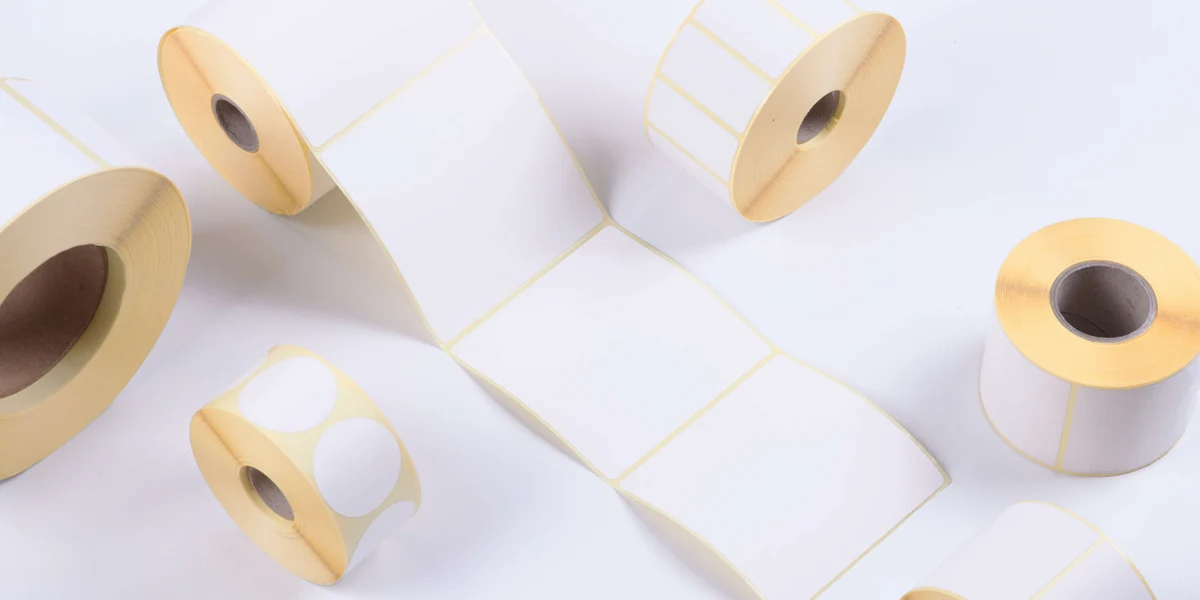
Choose thermal labels for recycled cardboard by testing the adhesive on the actual boxes, at the real application temperature, after dust and surface variation are considered. Recycled corrugated board can be rougher, more porous, and less consistent than smooth virgin linerboard. A general-purpose permanent adhesive may work on one box lot and lift from another, so the carton surface must be treated as a key specification.
The label face also matters, but most failures on recycled boxes begin at the bond. Strong initial tack helps the adhesive make contact with high and low points in the fiber surface. The best construction is not necessarily the most aggressive adhesive available; it is the one that stays attached through packing, storage, transport, and recycling requirements without creating printer contamination or unnecessary material cost.
Why Is Recycled Corrugated Board Difficult to Label?
Recycled fibers may be shorter and the liner surface may contain more texture, dust, coatings, or variable sizing. Adhesive touches only the peaks of a rough surface unless it can flow into the valleys under pressure. Carton lots can also differ by mill, recycled content, humidity, and converting process. Never qualify a label using only a smooth sample sheet when production boxes are rough or dusty.
Start With the Actual Application Surface
Collect boxes from more than one normal supplier and include the roughest lot you receive. Test on the outside liner, not on an unused inner flap, because printing, varnish, tape, and handling may change the surface. Avoid placing the label over a seam, fold, edge, or stretch film. If the box carries heavy ink coverage or a water-resistant coating, include that exact printed area in the trial.
Select Adhesive by Tack and Service Conditions
High initial tack is often useful on rough recycled board because the bond must form quickly during packing. Hot-melt and specially formulated acrylic adhesives are common options, but chemistry alone does not guarantee performance. Confirm minimum application temperature, service temperature, moisture exposure, dwell time, and whether cartons will be refrigerated or frozen. An adhesive applied to a warm, dry box can behave differently when applied in a cold loading area.
Cleanliness and Pressure Affect the Result
Loose fiber and corrugated dust form a weak layer between adhesive and box. Wipe the test area with a clean dry cloth when practical, but do not create a special preparation step that production workers will never follow. Apply the label with firm, even pressure across its full surface, especially at the leading edge. Record whether application is manual, with a wipe roller, or with a tamp applicator.
Choose a Label Size That Bridges Texture
A slightly larger label provides more bonding area and can bridge local surface irregularities, but extra size cannot compensate for an unsuitable adhesive. The label must still fit on a flat panel with room for the barcode quiet zones. Rounded corners reduce edge lifting. For automatic application, confirm that the size, gap, liner width, and dispensing direction are compatible with the applicator as well as the printer.
Use a Repeatable Carton Test
A short documented test is more reliable than pressing one label onto one clean box.
- Condition labels and cartons in the normal application area.
- Apply samples to at least ten boxes from several carton lots.
- Use the same pressure and record the application temperature.
- Inspect edges after fifteen minutes, twenty-four hours, and the expected transit period.
- Expose packed boxes to stacking, vibration, humidity, and temperature changes that match distribution.
Check Print and Barcode Performance Too
Corrugated adhesion is only half of the decision. Print the final barcode at normal speed and darkness, scan it before application, and scan it again after carton handling. Direct thermal paper is efficient for short shipping cycles, while coated paper or synthetic media may be better when abrasion, moisture, or long exposure threatens readability. Do not place the barcode where the box surface bows or where straps can cover it.
Consider the Recycling Stream
If recyclability is a purchasing requirement, ask for evidence about the complete label construction, not only recycled content in the facestock. Adhesive behavior during repulping can matter to paper recovery. Requirements and available certifications differ by market and recycler, so obtain current documentation for the intended packaging stream. A removable label is not automatically more recyclable, and a permanent label is not automatically disqualifying.
What Information Should a Supplier Receive?
Send representative carton samples or detailed photos, recycled-content information if known, surface coatings, application and service temperatures, expected journey, label dimensions, printer model, and application method. Compare shipping labels using the same test protocol. Ask the label supplier for the adhesive data sheet, sample-roll identification, storage guidance, and lot consistency information before approving a bulk purchase.
How Do You Control Performance After Approval?
Keep a retained label sample and a retained section of the approved carton. Record incoming label lots and investigate sudden edge lift against both label and carton changes. Train packers to apply labels only to flat, dry areas and to press the full surface. A simple receiving check—print, apply, wait, peel, and scan—can catch a material change before thousands of parcels enter the carrier network.
How Long Does the Adhesive Need to Build a Bond?
Pressure-sensitive adhesives often gain strength after application as they wet out the surface. A label that can be lifted easily after one minute may be secure after several hours, but parcels may enter conveyors immediately. Test both initial tack and later adhesion at the times that matter to the workflow. If boxes are stacked or chilled shortly after labeling, include those events in the early part of the trial.
Do not judge performance by an aggressive peel alone. Fiber tear can indicate a strong bond, but the operational requirement is that edges remain down and the barcode stays readable throughout distribution. Record edge lift in millimeters, full detachments, and whether failure occurs within the adhesive, between adhesive and carton, or by pulling fibers from the board.
Should Labels Be Applied Over Carton Printing?
Heavy ink, varnish, wax treatment, and water-resistant coatings can change surface energy and block adhesive contact. When possible, reserve an uncoated label panel on the carton artwork. If the barcode must cover printing, qualify the exact ink and coating combination after normal curing. A label that bonds to plain recycled board may not bond to a glossy printed patch on the same box.